
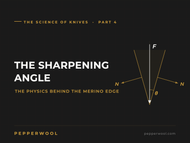
THE SHARPENING ANGLE
Posted by Beren McKay on Jul 2nd 2026
Sharpening · Edge Geometry
The Sharpening
Angle
What the sharpening angle actually controls — the trade between a keen edge and a tough one — and how to choose where yours should land. Less a magic number than a dial you set on purpose.
The Science of Sharp — jump to any part
Part 1 · Why a Smaller Angle Cuts Easier
Part 2 · Why Sharp Stays Sharp
Part 3 · What Your Steel Will Allow
Part 4 · The Sharpening Angle — you're here
Part 5 · The Mediums (coming soon)
Part 6 · The EDC Sharpening Method (coming soon)
Ask ten people how to sharpen a knife and one question comes back more than any other: what angle? It's the first thing a beginner wants a number for, and the thing experienced sharpeners will argue about all night. And almost every answer you'll find online hands you a number without telling you what the number is for.
Here's the part that makes the whole question simpler. The sharpening angle isn't a magic setting you either nail or miss. It's a dial — and you've already met both of the things it sits between.
How It Works
What the Angle
Actually Sets
In Part One we covered keenness: a more acute edge is a shallower wedge, so it cuts with less force. In Part Two we covered durability: that same acute edge has less steel behind the honed edge, so it rolls and chips more easily. Those aren't two separate facts. They're the two ends of one dial — and the sharpening angle is where you set it.
Grind the honed edge to a lower angle and you move toward keenness: the knife cuts like it's barely trying, and it surrenders that edge faster. Raise the angle and you move toward durability: the edge asks for more force to push through a cut, but it shrugs off the contact that would wreck a finer one. There is no setting that maximizes both. Every angle is a position between them.
Move the dial below and watch the trade happen.
Interactive Diagram
The Angle Dial — Keenness vs. Edge Strength
Drag the angle. The cross-section narrows or thickens, the two meters trade against each other, and the marker slides along the spectrum below — from razor-keen on the left to abuse-tough on the right. There's no setting that lights up both.
Notice there's no winning zone — no single angle the meters reward. Slide to the keen end and keenness lights up while strength falls away; slide to the tough end and they swap. The "best" angle is simply the point on that dial that matches what you're about to ask the knife to do.
The Spectrum
From Razors
to Axes
The full range is wider than most carry knives ever touch, and seeing the extremes makes the middle obvious.
At the keen end — somewhere around 15° included, under 8° per side — you get straight razors, scalpels, and fine kitchen slicers. Edges that part skin and tomato with no felt resistance at all. They're also the most fragile edges in use: a razor that met a stapled box or a bone would fold on contact. They live that low because they only ever cut soft, consistent material — and they get stropped or swapped constantly.
At the tough end — 40° included and up — you get machetes, axes, cleaver edges, hard-use survival blades. They take real force to push through a slice, but they survive being driven into wood, bone, and the occasional hidden nail without complaint. The angle buys robustness, and the job pays for it.
Almost every pocket knife you'll ever sharpen lives in the band between those two. Where in that band is the actual question.
When the Job Decides
When You Don't
Want Acute
So far we've been chasing keen. But the job decides the angle — and sometimes the job wants the opposite: a honed edge that's the wrong answer even when you could grind it sharp. The clearest case is a chopping tool: an axe, a machete, a heavy camp knife.
A chopper still has to be sharp enough to bite — a blunt one just bounces off the wood. But it earns its living through impact, slamming into hard, knotty, irregular material over and over. Put a thin, acute edge on that and the honed edge chips or rolls on the first hard knot. So a chopper wants a deliberately larger honed angle: sharp enough to penetrate, but with enough steel right behind the honed edge to take the shock without bending or chipping. You give up effortless slicing to buy an edge that survives being hammered into things.
That's the honest other side of this whole series. A smaller angle cuts easier — but "cuts easier" and "right for the job" aren't always the same sentence. The chopper isn't badly sharpened; it's sharpened for impact instead of slicing. Which brings us to the knife most people actually carry, and the job it's really being asked to do.
What It Means for Your Carry
Where an Everyday
Edge Wants to Live
An everyday carry knife doesn't get to specialize. It opens boxes with staples buried in the flap, breaks down packaging, cuts lunch at a desk, trims a loose thread, and every so often does something it shouldn't. That mix is the design problem: keen enough to feel good on the easy ninety percent, tough enough to survive the careless ten.
That lands most EDC edges somewhere around 25 to 30° included — roughly 12.5 to 15° per side. Low enough to slice cleanly, high enough to take a week of abuse without rolling. Within that band, lighter cutters drift lower and harder-use folders sit higher. It's a window, not a point.
Two things let you push toward the keen end of that window without paying for it in chipped edges. The first is a micro-bevel: grind the primary bevel thin for easy cutting, then lay a tiny, slightly steeper honed edge on top of it — a knife that slices like a fine edge but carries a durable working tip. The second is the steel. A finer, more stable steel holds a more acute honed edge without folding — which is exactly what Part Three was about. The steel sets how low you're allowed to go. The angle is you spending that allowance.
Test it at home — the pencil
Sharpen one pencil to a long, needle-fine point and another to a short, stubby one. The needle point writes the finest line — and snaps the instant you lean on it. The stubby point is blunt, but you can press hard and it holds. Same wood, same graphite; the only variable is the angle of the point. That's the entire trade sitting in your hand, and it's the same trade your knife's honed edge makes every time you sharpen it.
There is no sharpest angle.
Only the angle that fits the work.
A razor and an axe are both perfectly sharpened — for completely different jobs.
Where the MERINO Line Sits
20–25° included · 10–12.5° per side
Toward the keen end of the EDC window, on purpose. That edge slices like a much finer knife — and it only holds there because it's CPM S35VN run to 60–62 HRC, a steel stable enough to keep a fine honed edge through real use. The angle is the ambition; the steel is what makes it safe to ask for.
The Other Half
An Angle Is a Target.
Next Is How You Hit It.
Knowing the angle you want is one thing. Putting it on a blade — evenly, repeatably, without rounding off the very honed edge you're trying to refine — is another. The tool you reach for decides how easily you actually land the angle you chose: a stone, a diamond plate, a belt, a rod each behave differently and forgive different mistakes. That's Part Five.
And for the decision behind the MERINO line's edge — why we set it where we did, and what it took to get there — read Why S35VN: The Steel Decision Behind the MERINO Line.