The Founder Story
Why
Pepperwool
Exists.
This is not a brand story about finding a gap in the market. It's a story about a room that went silent — and what that silence cost.
I — The Development Machine
Mass production changes everything
about how you design.
When I joined SOG Knives in 2010, the company was in the middle of a transformation. The strategy was shifting from smaller volumes of carefully handcrafted knives toward high-volume mass production — and nobody had quite figured out what that meant for the people responsible for the products.
I was handed the chaos and told to fix it.
When a skilled craftsman builds your knife by hand, the design can have gaps — you're collaborating with someone whose judgment fills them in. On an assembly line, there's no such collaboration. If the design is flawed when it leaves your desk, it's flawed when it arrives in 10,000 boxes. And there's no fixing it.
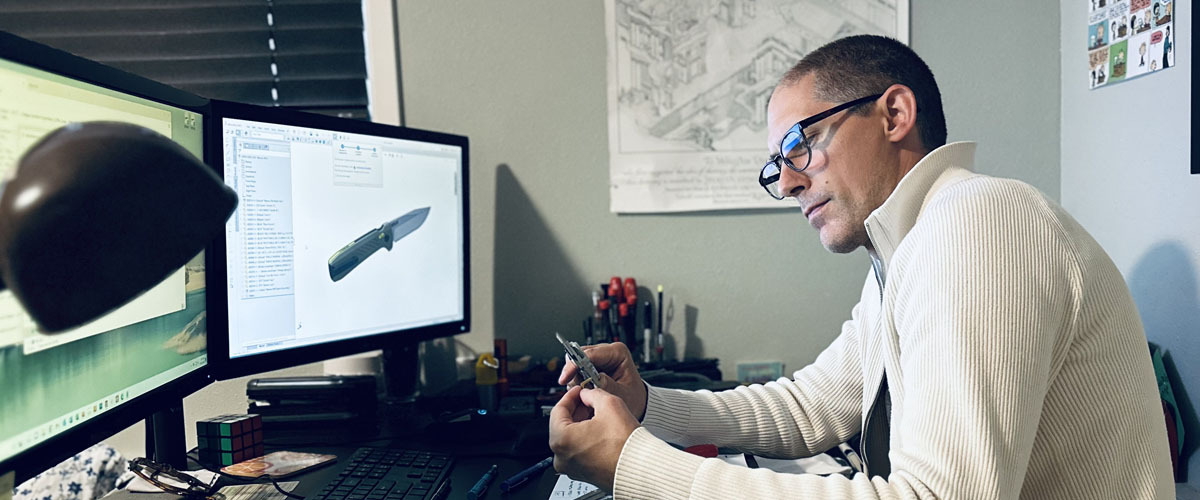
So I learned. I spent the next seven years reading patents, studying material science, spending time on factory floors — both the craftsman shops and the mass production facilities. I have a gift for learning things quickly, and I applied it obsessively. I learned not just how to design knives, but how to invent the manufacturing processes that make them.
By 2017, I had built the product
development team at SOG
from one person to twelve.
Development cycle: from five years down to eighteen months. A system — quality control, prototyping, IP protections, synchronized checkpoints with marketing and sales. Efficient. Coordinated. Fast.
II — The Silence
I asked my team a simple question.
We were in a meeting, and I asked: Which of our knives are you proud of? Which ones do you show to your friends and family?
The room went silent.
I looked at that silence for a moment. Then I walked to the whiteboard and erased everything on it.
If we — the people who design and build these knives — aren't proud of any of them, why would anyone else want to own them?
That day, we designed a knife that we actually wanted to carry. We went through every element — blade steel, mechanism, handle material, size, shape — and we made the choices we'd been too constrained to make before. If you've ever picked something up and felt it was almost right but not quite, you know exactly the gap we were trying to close. I named it the Terminus. In my head, it was the last knife you'd ever need to own.
The sales team pushed back hard. They said it wouldn't sell. The numbers didn't support it. The price point was wrong. The market didn't want it.
I had spent seven years learning what it takes to make something right. I was not going to unmake it because a spreadsheet disagreed.
I pushed it through. When the physical samples came back, something shifted. People picked it up and didn't want to put it down. The sales team changed their minds.
The Terminus was proof of concept
for consumer-centered product design.
The idea that the person carrying the knife had to be the starting point, not an afterthought. Together with a new head of marketing, we built on that insight. We relaunched the brand as Studies and Observations Group. The products were called the best in the industry. The company grew fast.
III — The Cost
Then the ownership
decided to sell.
I won't pretend I was at peace with it at the time. I wasn't. A lot of people had poured years of hard work into turning SOG into something worth being proud of, and the sale made clear that the new owners had a different direction in mind. The work we had done — building a brand that cared about quality and the people carrying its products — wasn't going to continue the way we'd built it.
I had spent twelve years at SOG. I had given up the dream of starting my own brand because I believed in what we were doing there. The sale took that decision out of my hands, and handed me back the dream I had let go of.
So I started Pepperwool.
I had watched what outside ownership did to a brand that people had poured their hearts into. I had watched the pressure to cut, to compromise, to let the standard slip because someone else's priorities changed. I wasn't willing to build something I believed in and then hand someone else the power to do that again. So I self-funded the entire operation. Every dollar mine. Every decision mine. Every consequence mine.
I thought I'd have a product to market within a year, maybe eighteen months. I knew how to do this — I had built the systems, I had the factory relationships, I knew the process cold. What I hadn't accounted for was the difference between leading a team of twelve and doing it alone — and alone meant truly alone. No tools, no capital, no infrastructure. Everything I had taken for granted at SOG had to be built or acquired from scratch.
It took three years.
The MERINO MM launched in 2025. It is, in every meaningful sense, the product of everything I learned — about manufacturing, about design, about what it actually takes to make something that earns a place in your daily life and stays there. Not a disposable product. Not something designed to be replaced. Something made with the conviction that if you're going to carry one knife, it should be the right one.
That silence in the conference room in 2017 never really left me. It's the reason Pepperwool exists.
The Answer
Every Pepperwool knife starts with one question:
would I actually carry this?
Not would it sell. Not would it test well. Would I — the person who built it — carry it every day. If the answer isn't yes, nothing happens. Not because of a rule. Because that's the cost of making something you'd actually want to own.
The Name
Pepperwool
People once crossed oceans for pepper, at real risk, because it turned something ordinary into something exceptional — a small spark that made every day a little better. That's what a new idea should do.
Wool kept those same people warm and dry on rough seas. Practical. Durable. The thing you trust without thinking about it.
Pepperwool is both: the spark of a better way to do something, and the reliability to carry it every day. The mark holds them too. The crosshatch at its center is woven wool; the diamonds around it are flecks of pepper.
Every time that mark goes on something, I ask whether it lives up to the name.
The Work
What three years
of refusing to compromise
looks like.
The MERINO line is the product of everything in that story — down to two mechanisms I've spent years getting right. The Kip deploy™, first worked out with my team at SOG and rebuilt for MERINO. And the Keeper clip™, which catches the hem so the knife can't leave without you, and lets go the moment you mean it.
Both had to answer the question above before either one shipped.
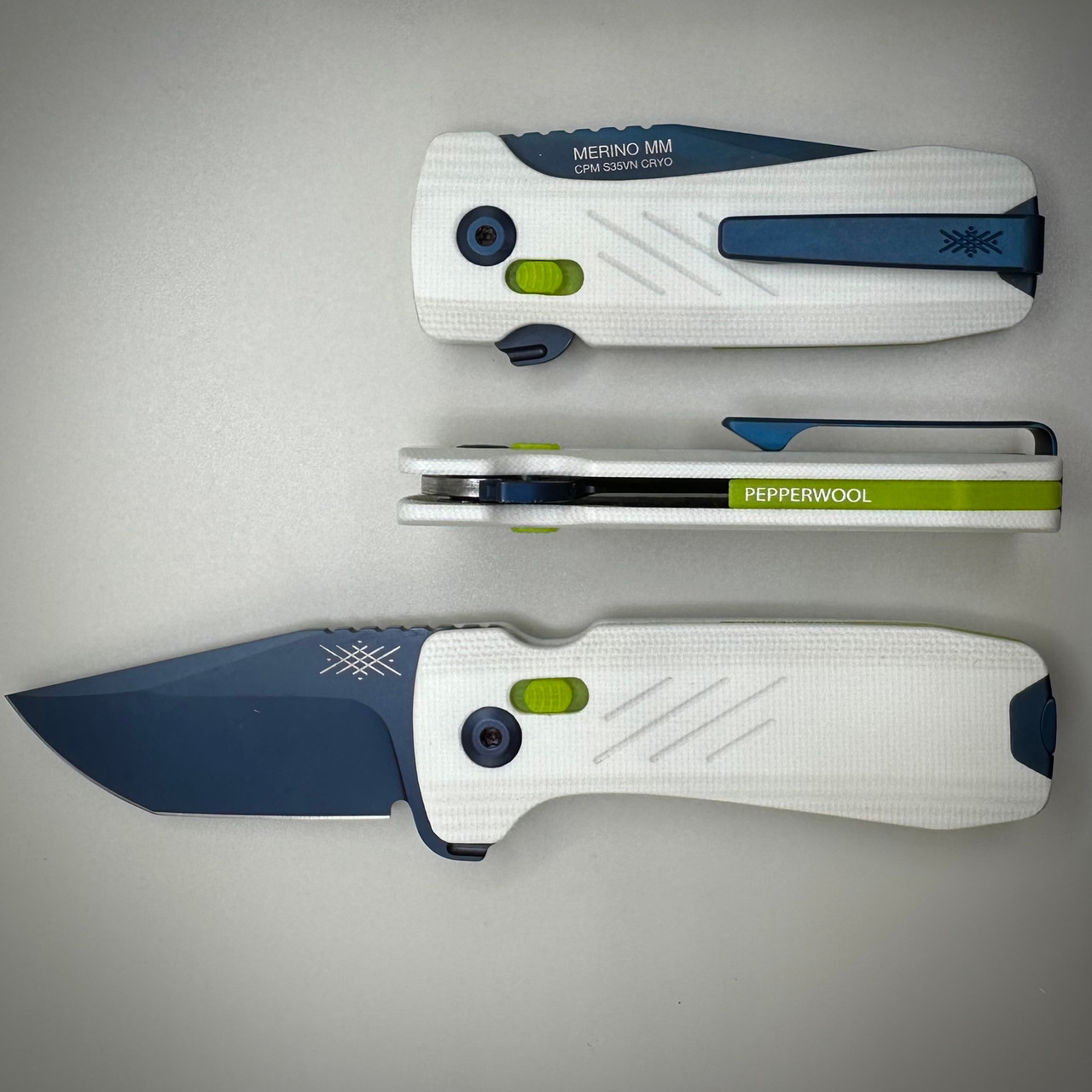
MERINO MM · S35VN · 1.6 oz · $129.99