
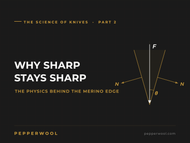
WHY SHARP STAYS SHARP (OR DOESN'T)
Posted by Beren McKay on Jul 2nd 2026
Edge Retention · Longevity
Why Sharp Stays
Sharp (or Doesn't)
Two knives can leave the stone equally sharp and lose that edge at completely different speeds. The reason is geometry — and it's why the sharpest knife on day one isn't the one that stays sharp.
The Science of Sharp — jump to any part:
Part 1 · Why a Smaller Angle Cuts Easier
Part 2 · Why Sharp Stays Sharp — you're here
Part 3 · What Your Steel Will Allow
Part 4 · The Sharpening Angle (coming soon)
Part 5 · The Mediums (coming soon)
Part 6 · The EDC Sharpening Method (coming soon)
A knife is sharp, or it's dull. That's how most people carry the idea around. Sharpen it and it's sharp; use it a while and it's dull; sharpen it again. And the sharpest knife on the day you get it must be the one that'll serve you longest. Both of those ideas are wrong, and the space between them is the most useful thing you can understand about an edge.
Sharpness isn't a state an edge sits in. It's a moment an edge is passing through. From the very first cut, every edge is on its way back to dull — the only real question is how fast, and that rate has a name: edge retention. Two knives can come off the stone equally, genuinely sharp and then lose that edge at completely different speeds. Understanding why is the difference between owning a knife that impresses you in the drawer and carrying one that's still working on Friday.
How It Actually Works
Dull Isn't a State.
It's a Process.
Strip away the romance and an edge is just a line — the honed edge, where the two faces of the bevel meet. "Sharp" means that line is fine: a small enough radius that it parts material instead of shoving it aside. (Part One covered why a thinner edge cuts with less force — if you haven't read it, start there.) Dulling is that line getting wider, rougher, or bent out of true. And it happens three different ways, which is the part almost nobody separates out.
What "Dull" Actually Is
Abrasive wear. Every material you cut grinds microscopically back against the honed edge. Over many cuts it rounds and widens. Slow, even, unavoidable.
Rolling. The honed edge bends to one side under sideways load. The steel is still there — it's just folded over. This is why a "dull" knife can sometimes come back with a few passes on a steel.
Chipping. A piece of the honed edge fractures and breaks away, leaving a tiny gap that drags and tears. Usually from hitting something hard — a staple, a bone, a ceramic plate, grit hiding in cardboard.
Test it at home — the pencil. You don't have to take this on faith. Sharpen a pencil to a fine point, drag it across a sheet of paper, and lift it to check the tip every few passes. You'll watch the point round and broaden — exactly the way a honed edge does. Dulling as a process, not a switch. Now run the same test on something rougher, like fine sandpaper, and the point goes faster: the medium you cut decides how quickly it wears. Change the pencil's hardness, or how fine you sharpen the point, and you can test the other two variables — steel and edge angle — that the rest of this series takes up.
Here's what surprises people: most of the time a knife "goes dull fast," it isn't abrasive wear at all. It's rolling or chipping — the honed edge taking damage from a hard contact it wasn't built to survive. And whether it survives that contact is, more than anything else, a question of geometry.
The Physics of Dull
Dullness Is Just
Force ÷ Area
There's a precise way to say what "dull" means, and it's the same physics from Part One. Pressure is force divided by area. A sharp edge meets the material along a vanishingly thin line — almost no area — so even a gentle push delivers enormous pressure, and the material splits. As the edge wears, that line widens into a flat. The area grows. And to deliver the same splitting pressure across a bigger area, you have to push harder.
That's dullness in one sentence: the contact area grew, so the force you need grew with it. It's the same engine as Part One's wedge, run the other direction — there, a more acute angle handed you more separating force for free; here, a worn, wider tip charges you more force for the very same cut.
Interactive Diagram
A Worn Edge — Area & the Force to Cut
Add wear and the worn tip flattens into a wider contact — more area, so more force to reach the same cutting pressure. Now hold the wear and drag the angle: the same wear leaves a far smaller flat on an acute edge than an obtuse one. Acute edges turn wear into dullness more slowly.
That last move is the one that ties the two posts together. Wear takes the very tip back by some amount no matter the angle — but how much flat that creates depends entirely on the angle. Grind the same sliver off an acute edge and an obtuse one, and the acute edge ends up with a far narrower flat. Same wear, less dullness, less added force. A keen edge doesn't just start easier — it stays easier, because it converts wear into dullness more slowly.
So we'd want the most acute edge we can get — for the cut on day one and for how slowly it fades. The catch is the one Part One hinted at: acute edges are fragile. The question driving the rest of this series is whether we can make a keen edge tough enough to survive real use — to resist the wear and the damage that widen it. And that turns out to be a question about steel.
The Mechanism
Why Two Equally Sharp
Edges Don't Stay That Way
This is where Part One's lesson cuts both ways. A thinner, more acute edge cuts with less force — but "thinner" also means there's less steel sitting directly behind the honed edge to hold it in place. The same geometry that makes an edge glide makes that honed edge easier to roll and easier to chip. Push the angle low enough and you get an edge that's breathtaking for one cut and folded over by the tenth.
Two things are doing the work. The edge angle — how acute the V is — and the thickness behind the edge — how much steel backs the honed edge a hair above the edge itself. A 15-degree edge on a thin grind is keener and weaker. A 22-degree edge on a thicker grind takes more force to start a cut but shrugs off the kind of contact that would wreck the keener one. Neither is better. They're answers to two different questions.
Keenness and durability pull in opposite directions.
Geometry decides where you land between them.
There is no angle that wins both. There's only the angle that's right for what the knife actually has to do.
The Honest Trade-Off
The Trade You Can't Cheat
With Geometry Alone
Day-one sharpness turns out to be a poor predictor of how long an edge lasts. A mirror-polished honed edge feels the keenest the instant it touches your thumb — but on fibrous material like cardboard or rope, a slightly coarser, "toothier" edge often out-cuts it for longer, because it has dozens of tiny cutting points to lose instead of one smooth line to round off. The knife that wins the showroom thumbnail test isn't always the knife still cutting clean at the end of the week.
So if geometry sets the trade between keenness and durability, what lets you move the whole trade further — hold a more acute edge and have it survive? That's the steel. How hard it is, how it resists wear, what its carbide structure does to the honed edge at a microscopic level — that's the subject of Part Three. Geometry is the frame. Steel is what you're allowed to do inside it.
What It Means for Your Carry
The Edge That Matters
Isn't the Keenest One
An everyday knife doesn't live in a controlled test. It lives in a pocket and comes out for whatever's in front of you — cardboard with a staple buried in the flap, packing tape, a zip tie, lunch on a hard plastic board, the occasional thing you shouldn't be cutting with it at all. That's an abrasive, careless, mixed environment, and it's brutal on a honed edge tuned for one clean push-cut.
So the edge that matters for carry isn't the one that's keenest on day one. It's the one that holds a working sharpness through a week of that — still opening the box, still slicing clean, without a trip to the stones every other day. That's a geometry chosen for sustained real cutting, not for a photograph. It's a quieter spec than "scary sharp out of the box," and it's the one you actually feel.
The Other Half of the Answer
Geometry Sets the Stage.
Steel Decides the Run.
Geometry tells you how an edge will behave. Steel tells you how long it'll keep behaving that way under load — and that's where the MERINO line's choices were made: a flat grind and an edge geometry set for sustained everyday cutting, in S35VN run to 60–62 HRC so the honed edge it's given can actually survive the week. Which steel, specifically, out of everything available — and what choosing it costs — is its own decision, told where decisions get told.
— Beren McKay
Founder, Pepperwool