
WHY YOUR COWORKERS REACT TO YOUR KNIFE
Posted by Beren McKay on Jun 19th 2026
Carry · Workplace
Why Your Coworkers
React to Your Knife
The knife sends a message before it's opened. That message is a design problem — and it's solvable.
Your assistant jumped when you opened the mail with it. You weren't doing anything wrong. The knife was.
You'd had it for years. You used it for boxes, for tape, for the loose thread on your sleeve — for the same things everyone uses a pocket knife for. But the second the blade came out at your desk, something changed in the room. A small step back. A pause in the conversation. A glance that wasn't there a second ago.
You wanted to say: it's just a tool. But you didn't, because the moment had already passed, and the only thing left to do was close it quietly and put it away. Maybe leave it home tomorrow.
The Signal
What's Actually Happening
in Their Head
Threat perception isn't rational. It runs ahead of the conscious mind, sorting objects into categories before the prefrontal cortex has a chance to weigh in. By the time your coworker has registered what they're looking at, the categorization has already happened. The reaction you saw on their face was the readout of a decision their brain made several beats earlier.
The categorization is fast because it has to be. Across the long run of human history, the cost of treating a weapon as a tool was higher than the cost of treating a tool as a weapon. So the brain leans toward the more conservative read. When in doubt, it flinches. The flinch costs almost nothing if it's wrong. Not flinching, historically, could cost everything.
What the brain uses to make the call isn't the object's actual function. It's the object's signals — color, profile, material, the way it deploys, the aesthetic vocabulary the design is borrowing from. A blade can be objectively identical in two knives and read as a kitchen tool in one and as a weapon in the other, because the surrounding cues are doing all the categorization work. The blade is barely being considered at all.
This is the part most knife carriers underestimate. You see your knife and you see what you use it for. Your coworker sees your knife and sees what the design communicates. If the design is borrowing from military or tactical aesthetics — the visual languages that signal combat readiness — your coworker is reading those signals accurately. The knife is telling them what it's for. They're just listening.
The Signal
Threat perception is a design signal problem
The brain categorizes objects as tool or weapon before the conscious mind weighs in. It uses color, profile, and aesthetic vocabulary — not the actual function.
The Design Answer
The message is solvable at the design level
A knife can be designed so that the categorization comes out tool, not weapon, before anyone sees the blade. Color, profile, and clip can be chosen to make that reading the natural one.
The Real Binding Constraint
The knife sends a message before it's opened. That message is your problem to solve, not your coworkers'. Not because they're being unfair — because they're reading what the design is broadcasting. A knife that broadcasts tool gets treated like a tool. A knife that broadcasts weapon gets treated like a weapon.
The legal answer to "can I carry this at work" is, in most jurisdictions and most workplaces, yes. We've covered the legal threshold in detail, and it's more permissive than most people assume. But the legal answer was never the binding constraint. The binding constraint is the moment the knife comes out. And nothing in the legal answer addresses that moment.
The Design Answer
The Color Palette Decision
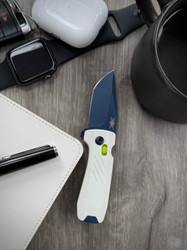
When we designed the MERINO MM, the question wasn't how to make a knife that looked different. It was how to make a knife that read differently — one that would broadcast tool the way a utility knife or a pair of scissors broadcasts tool, so clearly that the categorization never became a question. A knife that would blend into everyday life and everyday clothes, so it wouldn't grab attention in the moments attention is the last thing you want.
The palette started with the hardest problem: the blade.
The blade came first because the blade is the hardest to color. In the knife world, blades come in two finishes: silver or black. Both are fine. Neither is distinctive. And black, in the visual vocabulary the modern eye has been trained on, sits inside the tactical palette — it's the default finish of combat knives, military tools, and the entire aesthetic language of things designed for use against people. We wanted something that had no connection to that language at all.
Titanium Nitride, the coating used on the MM's blade, can be manipulated with heat to shift color. But the process is unforgiving. Dark blue sits in an extremely narrow band of precisely controlled temperature for exactly the right duration. Too hot, too long, and you're past it. Too cool, too short, and you haven't arrived. The factory we work with wouldn't attempt it at first. They'd never been asked to color-match a blade to that specification, and the consistency required for production seemed unrealistic.
It took six to eight months of development to make the dark blue repeatable and consistent at production scale. The process had to be dialed in until the color was not just achievable but reliable — knife after knife, batch after batch, the same dark blue.
The result is a blade color that has never appeared on a production knife before. And that matters, because when the eye encounters it, there's no existing category to file it into. It doesn't read as tactical. It doesn't read as military. It reads as something chosen on purpose — something considered — the way the color of a well-designed consumer product reads as intentional. A blade that looks like someone cared about what it looked like.
The blade color has never appeared on a production knife.
The eye has no existing category to file it into.
It doesn't default to tactical. It defaults to intentional.
Safety yellow came next. Dark blue on its own is striking, but it's still just a blue knife. The pop of color that completed the palette came from a specific place: the outdoor world. Dark blue and safety yellow is a combination you've seen a hundred times — on water bottles, on rain jackets, on backpacks, on hiking gear. It's the color language of the outdoors industry, and it reads immediately as civilian, active, and functional. Nobody has ever associated dark blue and safety yellow with a weapon.
White finished the palette. White is the color of consumer goods — kitchen appliances, medical devices, household tools. It's clean, and it creates contrast that makes the dark blue stand out rather than recede. Without the white, the knife reads darker and heavier than it is. With the white, the overall impression is lighter, more precise, more considered. More like something you'd find in a design store than in a tactical catalog.
The three together — dark blue, safety yellow, white — form a palette that belongs in the outdoor and everyday-carry world the way a well-designed water bottle belongs there. The knife doesn't need to hide. It blends in. When it comes out of a pocket at a desk, it reads the way a good pen reads: as an object someone chose thoughtfully. The brain doing the fast categorization has no tactical signals to work with. The reading comes out tool. The flinch doesn't happen.
Every other decision on the knife was held to the same standard — the slim profile, the deep-carry clip, the 2.125" blade length. And if you've ever wondered where the legal line actually falls between a tool and a weapon, that question has a longer answer than most people expect.
What This Means
Invisible in the Wrong Rooms.
Present in the Right Ones.
The goal of carrying a knife is having one when you need one. Boxes arrive. Tape needs cutting. A package has to be opened. A loose thread has to come off. None of those moments require a weapon. All of them require a tool. If the tool you carry reads as a weapon, you will use it less, and at some point you will leave it home. The carry will fail not because of the knife's capability but because of the knife's signal.
A knife designed for the rooms you actually spend your days in is a knife designed to make the signal a non-event. Nobody flinches. Nobody steps back. Nobody asks. The knife comes out, the package gets opened, the knife goes back, and the conversation continues as if you'd used a pair of scissors. Which is what you should be able to do — because that's all you were trying to do.
That's what carry-first design means at the level of social environment. Not just slim enough to forget about in your pocket. Quiet enough not to interrupt the room when it comes out.
The Knife for Where You Work
MERINO MM
Designed to be invisible in the wrong rooms and present in the right ones. Dark blue, white, and safety yellow — a palette that broadcasts tool, blends into everyday life, and never requires explanation.
2.125" blade · 1.6 oz · CPM S35VN · Deep carry reversible clip
In stock · $129.99
Note: This post discusses workplace carry from a design and social perspective, not a legal one. Knife laws and employer policies vary by jurisdiction and by workplace. This is not legal advice. For specifics on your situation, consult a qualified attorney and your employer's policy documentation.