
IS A POCKET KNIFE CONSIDERED A WEAPON?
Posted by Beren McKay on May 13th 2026
Carry · Knife Laws
Is a Pocket Knife
Considered a Weapon?
Current as of May 2026. Knife laws change — verify your state's current law before you carry.
Legally, the answer depends on more than what the knife is. It depends on what it signals.
Someone asks why you're carrying a knife. It's a reasonable question, and you have a reasonable answer — you open packages, cut rope, deal with the dozen small things a day produces that are easier with a blade than without. But something in the question lands differently than you expected. As if the act of carrying required justification. As if the knife in your pocket were a different category of object than the one in the kitchen drawer.
That instinct — the one that made the question feel loaded — is worth examining. Because legally, it's not entirely wrong. Whether a pocket knife is considered a weapon isn't a simple yes or no. It's a question that most jurisdictions answer the same way: it depends.
The Legal Answer
Design and Intent
Both Matter
In most US jurisdictions, a pocket knife is not automatically classified as a weapon. It is classified as a tool — unless something about the knife itself, or the circumstances of its carry, tips it into a different category.
Most state criminal codes define a weapon as anything used, designed to be used, or intended for use in causing death or injury to a person. That definition is broader than it first appears: under strict reading, any object held with harmful intent can become a weapon. A shoe. A pen. A phone. The law recognizes this, which is why knife classification rarely stops at the object itself.
The factors courts and law enforcement actually evaluate:
- 01
Design
What was the knife made to do? A folding pocket knife designed for general utility is legally distinct from a double-edged dagger or a ballistic knife. Design communicates purpose before the carrier says a word.
- 02
Blade Length and Type
Many states set specific thresholds — blades over 3, 4, or 5 inches are subject to additional restrictions, or are classified differently than shorter folders. Certain blade types (dirks, daggers, stilettos) carry their own legal definitions regardless of length.
- 03
Intent
This is the factor most people underestimate. Carrying a legal knife for self-defense — and saying so — can change its legal classification in some jurisdictions. Courts have ruled that stated intent to use a knife as a weapon converts lawful possession into unlawful carry. The knife doesn't change. The framing does.
- 04
Context and Circumstances
Location, behavior, and surrounding circumstances all factor into how an officer and ultimately a court evaluates a knife possession situation. The same knife reads differently in different contexts — and the law accounts for that.
Beyond the Legal Definition
What the Knife
Communicates
The legal framework points at something most knife carriers already sense intuitively: a knife is read before it's used. What it looks like, how it's carried, and the whole picture around it shapes how it's understood — by the person next to you on the subway, by the coworker who catches a glimpse of it, and yes, by the officer who asks about it.
This isn't unfair. It's the same logic that governs almost every object we carry. A clipboard reads as professional. A file box reads as moving. A knife reads as whatever the knife, its carrier, and the situation add up to in that moment.
What Gets Read
Reads as weapon
- Long blade relative to handle
- Tactical or military finish
- Double-edged or dagger-style profile
- Worn visibly as if for display
- Carried or referenced in a threatening context
Reads as tool
- Blade proportioned for utility tasks
- Considered, civilian color palette
- Slim profile, pocket carry
- Used for everyday tasks, not displayed
- Carried consistently as part of daily routine
None of those factors override the law — a legal knife carried with a legal purpose is legal regardless of what it looks like. But they do shape the experience of carrying it: whether you hesitate to reach for it, whether someone asks about it, whether the situation around it stays uncomplicated.
The Design Response
When the Knife Makes
the Answer Obvious
The cleaner answer to "is this a weapon?" isn't a legal argument. It's a knife that makes the question unnecessary.
A tool that looks like a tool, sized for what you'll actually use it for, carried the way a person carries something they need — not displayed, not announced, not tactical — doesn't usually generate the question. It generates the same response as the pen in your pocket or the keys on your belt. Background. Unremarkable. Expected.
The MERINO DM was positioned with this in mind in a specific and deliberate way. Its 2.9-inch blade sits just under the 3-inch threshold that triggers carry restrictions in most US jurisdictions. That number wasn't arrived at accidentally. It represents the largest blade that clears the legal threshold that matters most — the one that governs everyday carry in nearly every environment you'll encounter. The law itself is built into the design.
Not a millimeter wasted.
Not a millimeter over.
A 2.9-inch blade is a design decision that tells you exactly how much thought went into where this knife was meant to be carried. The answer to "is this a weapon?" is in the number itself.
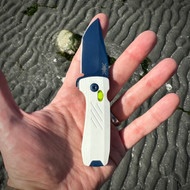
The MERINO MM takes the same conviction further in the other direction. At 2.125 inches, it clears every threshold in every jurisdiction — including the most restrictive environments in the country. The dark blue and white palette with safety yellow accents reads as considered and civilian. It's a knife that signals the right thing before anyone asks.
Neither knife is designed to avoid scrutiny by hiding what it is. They're designed so that what they are — a tool, chosen carefully, built for carry — is obvious at a glance. That's not a styling choice. It's a position.
Built to Answer the Question
MERINO DM
The largest blade that clears the threshold. Legal awareness built into the design — not as a workaround, but as a position.
2.9" blade · 2.0 oz · CPM S35VN · Deep carry reversible clip
In stock · $159.99
Also in the MERINO Line
MERINO MM — 2.125" blade · 1.6 oz · Clears every threshold, everywhere · $129.99
Note: This information is current as of May 2026. Knife classifications and carry laws vary significantly by state and jurisdiction and change over time. The information in this article is for general reference only and is not legal advice. Always verify the laws in your specific jurisdiction before carrying. If you have questions about a specific situation, consult a qualified attorney.