
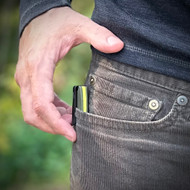
WHAT "CONCEALED CARRY" MEANS FOR A POCKET KNIFE
Posted by Beren McKay on Sep 12th 2026
Know Your Carry · Concealed Carry
What "Concealed Carry"
Means for a Pocket Knife
Current as of July 2026. Concealment rules vary by state and blade type — verify your jurisdiction's current law before you carry.
Most carry advice assumes hidden is always safer. For a narrow but real category of knives in a few states, the opposite is true — a visible clip is the legally cleaner choice, not the riskier one.
Every other post in this series has pointed the same direction: carry deep, stay below the pocket line, don't let the clip announce itself. That's the right social answer almost everywhere. It is not automatically the right legal answer — because a small number of states draw their actual statute around concealment, not visibility, and in those states the advice that keeps you invisible to a coworker can be the exact thing that makes the knife illegal to carry that way.
This post is the one place in the series worth slowing down on that default, because getting "concealed" wrong isn't a social misstep — it can be the actual legal violation.
The Concealment Test
What "Concealed"
Actually Means
Where a knife statute turns on concealment, the legal test is usually some version of "hidden from ordinary observation" — not hidden from a pat-down or a close inspection, but not visible to a reasonably observant person glancing at you normally. A knife riding fully inside a pocket, with no clip or handle showing, typically reads as concealed under that test. A clip that shows above the pocket line, in plain sight, typically doesn't — the knife is "open," even though most of it is still in your pocket.
For the large majority of ordinary folding-knife statutes, this distinction doesn't matter much — concealment isn't the trigger, and a closed folder is legal whether it's visible or fully tucked away. But a real minority of jurisdictions build their restriction specifically around concealment, and a few do it in the direction most people don't expect. California's dirk-and-dagger rule, covered in Pocket Knife Laws in California, is the clearest example: a fixed-blade dirk or dagger can generally be carried openly in a sheath, but carrying the same knife concealed is the offense. Open is the legal answer there. Concealed is the violation. It's the reverse of what most carriers assume by default.
The Real Binding Constraint
"Carry it hidden and you're safer" isn't a universal rule — it's a social rule that happens to align with the legal one almost everywhere, except the handful of places where it doesn't. The binding constraint isn't concealment itself. It's knowing which of the two rules — social or legal — your specific state and blade type actually cares about.
Social vs. Legal
When Visible Is the
Legally Safer Choice
Nine posts in this series have pointed toward deep carry as the answer, because in nearly every jurisdiction and for nearly every ordinary folder, it is — the social friction is real and the law doesn't require hiding the knife to begin with. This is the exception worth naming rather than glossing over: in the specific jurisdictions and blade categories where concealment itself is the restricted act, a clip that peeks out isn't a compromise on the social advice. It's the thing that keeps you inside the actual statute.
The honest takeaway isn't "always carry visible" any more than it's "always carry deep." It's that the two questions — will this draw a reaction, and is this legal — don't always point the same direction, and the only way to know which one governs your carry is to check your specific state's rule rather than default to either instinct.
01
The Legal Test
"Concealed" typically means hidden from ordinary observation — not visible to a normally attentive passerby. Most folder statutes don't turn on this at all. A minority do, and a few (like California's dirk/dagger rule) restrict concealed carry while permitting open carry of the same blade.
02
Social vs. Legal
Deep carry is the right social answer almost everywhere. In the narrow set of jurisdictions where concealment itself is the restricted act, a visible clip can be the legally cleaner choice — the two rules don't always align.
The Design Answer
What Reversible
Actually Solves
The MERINO line's clip is fully reversible — but reversible means it moves from the right side of the handle to the left, for a left-handed carrier or a different pocket habit, not that it swaps between hidden and visible. However you mount it, the clip's carry position is deep by design. That's deliberate: deep carry is the right social answer — and the right legal answer — almost everywhere covered in this series, so the knife is built to do that one thing well on either side rather than compromise it to cover a rare exception.
For the narrow set of places where visible carry actually turns out to be the legally cleaner choice, no clip mechanism resolves that for you. It isn't a hardware problem. It's a knowledge problem — and the fix is knowing the specific rule that applies to you, not a knife quietly guessing wrong on your behalf.
Deep Carry, Built for Either Hand
The MERINO Line
A fully reversible pocket clip — right side or left, for whichever hand and pocket habit is yours. Deep carry either way, because that's the answer that's right almost everywhere.
Deep Carry, Ambidextrous Reversible Clip · CPM S35VN
Explore the MERINO LineStart With the Everyday Carry
MERINO MM — 2.125" blade · 1.6 oz · The carry-first EDC, in stock now
Note: This information is current as of July 2026. Concealed-carry rules for knives vary significantly by state and by blade category (folder vs. fixed blade, dirk/dagger classifications, etc.) and change over time. This article is for general reference only and is not legal advice. Always verify your specific state and city's current concealment rule for your blade type before choosing how to carry, and when in doubt, consult a qualified attorney.