
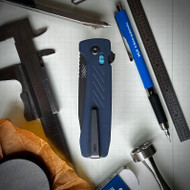
THE MORNING A SKEPTICAL FACTORY BECAME A COMMITTED ONE
Posted by Beren McKay on May 25th 2026
From the Inside
The Morning a Skeptical Factory Became a Committed One
The head engineer said the knife wouldn't hold up. I suggested the test lab. I hadn't planned on an audience.
He said it plainly. The new head engineer had looked at the MERINO Line drawings, walked through the mechanism, and arrived at a conclusion: a knife this thin couldn't survive what a pocket knife gets put through every day. No amount of math was going to change that.
I understood his position. To someone trained on the conventions of the category — who had spent years learning what a pocket knife is supposed to look like — the MERINO's proportions don't communicate strength. They look like a risk. And risks, in manufacturing, are expensive.
I asked if we could use the test lab.
Before the Factory
Three Years of Work
Before Anyone Saw It
The MERINO Line design was complete in June of 2023. Not complete in the sense of ready enough to hand off — complete in the sense of having been interrogated from every direction I knew before asking a factory to touch it.
The process ran in stages. First came dynamic mathematical models of the mechanism — the kind that let you stress-test a design before a single part exists. Then 3D CAD. Then proof-of-concept models I built in my own shop: 3D-printed housings, laser-cut parts, custom assemblies I could open and close and hold in my hand instead of evaluate on a screen.
Once those models answered yes — the mechanism worked, the geometry held, the carry dimensions were what the calculations said they'd be — I assembled the technical data packet: every file the factory would need to quote it, prototype it, and build it to a documented standard.
That's when the factory relationship starts. And that relationship, it turns out, is its own layer of the design.
The Context
A Smaller Community
Than You'd Think
The knife and tool manufacturing community in Asia is smaller than most people assume. If you've worked in it long enough — designed things that pushed the category, shown up on factory floors to solve problems in person — people know you. By the time the MERINO Line was ready, I had developed a reputation within this community for new and innovative designs. That reputation had a practical benefit: factories that knew my work knew that if I was asking them to do something outside the norm, I'd be there in person to figure out how to make it work.
There was also, I'll be honest, a kind of professional pride at play. Factories that had worked with my designs weren't shy about the fact that they considered it something worth noting. That relationship works in both directions — the unusual request gets taken seriously, and the factory gets the firsthand problem-solving that makes it possible.
The factory I chose for the MERINO Line was one I'd worked with for nearly a decade. The relationship was solid. What I didn't know, until I arrived for my onsite visit, was that the head engineer was new.
He had never seen one of my designs before.
A decade of factory relationship, and the person standing across from me on this visit was starting from zero.
The Moment
No Amount of Math
Was Going to Move Him
He was direct about it. He had looked at the construction — the profile, the proportions, the way the mechanism was designed — and he had concluded that a knife built this way couldn't withstand the demands of daily pocket carry. It would fail in the field. The engineering wasn't there.
I had the models. I had the calculations. I had three years of design work that said otherwise. I walked him through the math. He listened carefully and held his position.
Some disagreements resolve through conversation. This one wasn't going to. What he needed wasn't a better explanation — it was evidence he could hold in his hands and read off a machine. That's a reasonable position for a head engineer to take. It's the same position I would have taken in his seat.
The factory had an excellent accredited testing laboratory. I suggested we use it.
The Test
Thirty People
in the Lab
The next morning I walked into the laboratory and found thirty people.
Heads of production, assembly, engineering, quality control — half a dozen departments represented, most of them standing. Word had gotten around that someone was running a new design through the lab. The MERINO's unusual proportions, apparently, had made an impression overnight. People wanted to see what happened when the machines had their say.
I want to be honest about what that room felt like. I had done the math. I had built the proofs. I had done everything I knew how to do before that moment. And standing in front of thirty experienced factory professionals while they prepare to stress-test your work generates a specific kind of feeling that reviewing the calculations in your shop doesn't. You're confident in the work. You're also human.
I inspected the test samples — checked that they were representative, that the prototypes matched the design intent — and gave the go-ahead.
The Test Battery
Edge retention — measured cut performance over a standardized cutting medium to establish how the blade holds an edge under repeated use.
Flexure — lateral bending force applied to the blade to test structural rigidity under the kind of side-load stress that daily carry produces.
Torsion — rotational stress test on the blade and handle interface, measuring resistance to the twisting forces applied during use.
Lock strength — progressive load applied directly to the blade with the lock engaged, run until failure. The result is the maximum force the lock will hold before releasing.
The Result
Just Under
900 Pounds
Test after test, the MERINO samples didn't just pass. They exceeded what the room expected. Edge retention: above spec. Flexure: above spec. Torsion: above spec. The crowd recalibrated with each result — the silence in between tests getting a different quality to it.
Then came the lock strength test.
This one runs until failure. You apply increasing force to the blade with the lock engaged and hold until the lock releases. The number at failure is the result. There's no target to hit — the test runs until something gives, and then you read the number. Everyone in that room had a mental estimate. They had spent careers around knife production. They knew what a lock this slim, on a knife this light, should reasonably hold.
The lock broke at just under 900 pounds of force.
An audible hush went through the room.
The factory's specification for a knife this size requires a fraction of that figure. The MERINO had held to nearly a full order of magnitude beyond what their standard required.
Not incrementally stronger. Categorically different.
The head engineer found me. He shook my hand. He said he hadn't believed it was possible to build something that strong in a knife that carried like this. Now he had no doubt.
Why It Matters
The Handshake
Was the Standard
The engineers who build your knife need to understand what they're building. Not because belief changes the steel — but because the people who run the process, inspect the parts, and catch the problems do better work when they're invested in the outcome. They're not just filling tolerances. They know why the tolerances exist.
What happened in that lab that day wasn't validation for me. I had the models. I knew the math. What it was, was the moment a factory that had been skeptical became one that was committed — not to a customer's order, but to a design they had now seen prove itself in their own accredited facility, in front of their own people, to a result none of them expected.
The MERINO line carries the way it does because of a design conviction held through three years of refinement. It holds the way it does because the people building it understand exactly what it's capable of.
That handshake is built into every knife we ship.
The MERINO Line
MERINO MM
Slim enough to disappear. Light enough that you stop noticing it's there. Built to a standard the factory's own test lab confirmed — and then exceeded.
2.125" blade · 1.6 oz · CPM S35VN · Deep carry reversible clip
In stock · $129.99
Also in the MERINO Line
MERINO DM — 2.9" blade · 2.4 oz · The capability the MM leaves behind, the same carry philosophy · Pre-order $159.99 · Expected August 1, 2026