
WHY THE MERINO IS HONED AT 20-25 DEGREES
Posted by Beren McKay on Jul 2nd 2026
The Edge Angle
Why the MERINO Is Honed
at 20 to 25 Degrees
People ask me about the angle of the edge more than almost anything else on the knife. For a while I wondered why a number that small drew that much attention. Then I understood. They're not asking out of curiosity. They're asking because they're standing in front of a sharpener.
Almost every sharpening tool worth owning is angle-specific. The guided rod systems have a setting. The fixed jigs are ground to match one number. If you know the angle your blade was honed to, you set the tool to match, and the work is easy — you're refreshing an edge that already exists. Get the angle wrong and you're not sharpening anymore. You're re-dressing the blade: grinding a whole new bevel into the steel by hand, removing material, starting the edge over. It's slow, it's easy to botch, and most people end up doing it at least once — because nobody ever told them the original number.
So here's the number, and here's why it is what it is.
The Scale
What the Angle Actually Controls
Before the number means anything, one piece of housekeeping that trips up almost everyone. An edge angle can be stated two ways. Per side is the angle of one bevel measured from the centerline — the number you set when you work one side of the blade against a stone. Inclusive is both sides added together. A 22-degree inclusive edge is 11 degrees per side. They describe the same edge. Mix them up and you'll set your tool to twice the angle you meant to. Always check which one a brand or a tool is using before you match it. Everything below is stated inclusive.
The One Thing to Check First
Per side and inclusive are not the same number. Inclusive is both bevels together; per side is one. A 20–25° inclusive edge is roughly 10–12.5° per side. If a number looks twice as steep as you expected, that's why.
With that settled, the angle is a single tradeoff, and the whole thing follows from it. A narrower angle puts a thinner honed edge on the blade. Thin slices beautifully and takes less force to push through material — but it's more fragile, and it dulls into damage rather than into a soft edge. A wider angle puts more steel behind that edge. It's tougher and it survives abuse, but it doesn't bite the same way.
Roughly, in inclusive terms: down around 15 to 20 degrees is a slicing edge — keen, fast, and only as durable as the steel underneath it. Most steels can't live there; the metal is too coarse, the carbides too large, and the honed edge chips and rolls under ordinary use. Around 25 to 30 degrees is the all-purpose range — nearly any steel holds it, and it takes most of what daily life asks of a knife. Past 30 degrees you're in chopping territory. Those edges dull faster, but you're swinging the knife into wood, not slicing a tomato, so you don't feel it the same way.
For reference, a lot of knives leave the factory somewhere around 22 degrees inclusive. The better the steel, the further toward the keen end it can go without paying for it.
The Decision
Why We Land at 20 to 25
The target the MERINO MM and DM are honed to — set toward the keen end of all-purpose, where the steel lets us live without paying for it.
Two things decided that range: the steel, and the work.
The steel first. The MERINO runs CPM S35VN, hardened to 60–62 HRC. That matters here for a specific reason — it's clean, fine-grained, high-yield steel, the kind that holds a keen honed edge without it crumbling the first time you hit a staple in a box. A cheaper steel with coarser carbides can't be taken this thin; you'd grind a beautiful edge and then watch it chip away. Good steel is what buys you the option to go keen. We chose to spend that option rather than leave it on the table.
Then the work. The MERINO is a carry-first knife, and the honest task list for a knife you actually carry is almost entirely slicing — packages, boxes, a strap, food at your desk, the tag off a new shirt, a loose thread. It is not chopping. It is not prying. The blade length is built around that reality, and the edge is too. An angle tuned for abuse the knife will never see would be the wrong edge for the work the knife actually does. So we hone toward the keen end of the all-purpose range — where the steel is comfortable, and where the cuts you actually make get easier.
One thing I won't pretend about. The honed edge is applied by hand at the factory. I'm still astonished at how repeatably those people put the same edge on knife after knife after knife — but hand work is hand work, and I'm not going to hand you a single decimal-point number that implies a precision the process doesn't have. It's a target and a tight range. That's the honest way to state any factory edge, and it's the truth about ours.
And one more thing, because it's yours to decide, not mine. The steel will hold an edge keener than what we ship. We hone to 20–25 because that's the edge that serves the most people without asking anything of them — set your sharpener, match it, go. But if you understand how thin that honed edge gets, and you're willing to maintain it, the steel will take you finer. That's your call. We're not going to make it for you by refusing to leave you the room.
In Your Pocket
What This Means When You Sharpen
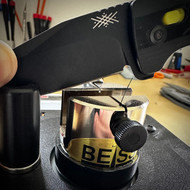
When your MERINO finally asks for a touch-up — and with S35VN that's later than you're used to — you don't have to guess. Set a guided sharpener to match a 20–25 degree inclusive edge, or do what works on any knife and simply match the bevel that's already there. A few light passes brings it back. No re-dressing, no grinding a new bevel, no afternoon lost to fixing a mistake you didn't know you were making.
That's not a small thing, and it's not separate from the carry. A knife that's a chore to keep sharp is a knife you eventually stop carrying. Telling you the number is part of building one you don't put down.
Beren