
WHAT SIZE POCKET KNIFE IS LEGAL TO CARRY?
Posted by Beren McKay on Apr 29th 2026
Carry · Knife Laws
What Size Pocket Knife
Is Legal to Carry?
Current as of April 2026. Knife laws change — verify your state's current law before you carry.
The legal answer is simpler than most people think. The more useful answer goes further.
You've been there. You pull out your knife to cut something — a zip tie, a price tag, the plastic seal on a package — and you catch someone watching. Not alarmed. Just watching. And you notice yourself calculating: is this knife making someone uncomfortable? Is it too big for this moment? Is it even legal here?
That hesitation is information. It means the knife you're carrying might be the right knife for the worst-case scenario you've imagined — but not quite right for the life you're actually living.
The Legal Landscape
The Law Is Simpler
Than You Think
In the United States, knife law is almost entirely a state matter. There is no single federal blade length limit for everyday carry. What exists at the federal level — the Switchblade Act of 1958 — governs interstate commerce in automatic knives. Everything else is handled state by state, and sometimes city by city on top of that.
The practical result: the same knife that's entirely legal in Arizona can create legal exposure in New York City. A blade that's fine clipped to your pocket in Texas might require a different approach in Nevada. This isn't an argument against carrying. It's an argument for knowing where you stand.
The threshold where most knife restrictions in the United States begin. Carry a folding knife under this length and you're legal in the overwhelming majority of jurisdictions in the country.
That's not a universal rule — some jurisdictions set the threshold at 2.5 inches, others at 4, and some have eliminated blade length limits for folding knives entirely. But sub-3 inches is the number that clears the most ground without requiring you to research every county line.
A Few States Worth Knowing
- California Folding knives are legal to carry concealed with no statewide blade length restriction, as long as the blade is folded. Fixed-blade knives, switchblades over 2 inches, and dirks face stricter rules. Local ordinances in cities like Los Angeles may add further restrictions.
- Texas On the permissive end. Adults can carry most folding knives without restriction; limits apply primarily to specific locations like schools and government buildings.
- New York City One of the most restrictive environments in the country, and one that requires its own calculation. The sale restriction on locking folding knives applies at blades of 4 inches or more — so most EDC folders clear that threshold on blade length alone. The more consequential rule is visibility: any portion of the knife in public view, including the pocket clip, is prohibited. A deep carry clip that disappears below the pocket line is the right tool for NYC, but enforcement has been aggressive enough that knife advocacy groups recommend removing the clip entirely before entering the city. Know the environment before you go.
- Federal Property Courthouses, TSA checkpoints, and government buildings operate under separate restrictions regardless of what your state permits. These are universal no-carry zones for any knife.
The honest summary: a folding knife with a blade under 3 inches, carried legally under your state's concealed carry rules, will clear the legal threshold in nearly every situation you'll encounter. Anything beyond that requires you to know the specific rules of wherever you're going — and to check before you cross a state line.
The Threshold Nobody Talks About
Legal Isn't the
Binding Constraint
Here's what the blade length question is actually asking, underneath the legal framing:
What size knife can I carry
without it becoming a problem?
That question has two layers that most people collapse into one.
The first layer is legal. We've covered that.
The second layer is social. And it's the one that actually determines whether most people reach for their knife or leave it in the car.
A knife that clears every legal threshold can still be the wrong size for a given moment. Too long a blade and you're making a statement you didn't intend — on public transit, in a coffee shop, at a work lunch. The person next to you doesn't know your blade is 2.8 inches. They see a knife. What they feel in that moment is a function of what the knife looks like, how it's used, and whether the whole picture reads as a tool or something else.
This is the threshold that actually governs daily carry for most people. Not the law. The room.
There's also a third layer, closely related: the professional environment. An office, a meeting, a client lunch. A knife you'd hesitate to open at your desk has already failed, regardless of what the employee handbook says. The question isn't just whether you're allowed to carry it — it's whether you'll actually reach for it when you need it. In the spaces where you spend most of your life.
The Design Problem
What "Just Right"
Actually Means
The knife that works in every situation isn't the biggest knife that's technically legal. It's the knife that's large enough to handle what you'll actually need — and calibrated precisely enough that it doesn't require a second thought from anyone watching.
For everyday tasks — opening packages, cutting tags, slicing through tape, dealing with the dozen small cutting needs of a normal day — a 2 to 2.5 inch blade handles everything. It handles everything at a size that registers as a tool, not a statement. That's not a compromise. That's the correct answer to the problem.
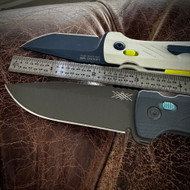
The MERINO MM has a 2.125-inch blade. That number wasn't chosen because it was the minimum that would work. It was chosen because it's the size where legal clearance, daily utility, and social permission all converge. Short enough to carry legally in virtually every jurisdiction in the country. Long enough to handle what you need. And small enough that opening it at your desk, on public transit, or in a café doesn't change the temperature of the room.
The color choices on the MM carry the same intent. Dark blue and white with pops of safety yellow — a palette that reads as intentional and tool-oriented rather than tactical. The knife that says someone chose it carefully, not someone preparing for a confrontation. That signal matters in the room just as much as the blade length does.
The MERINO DM takes the same philosophy further. Its 2.9-inch blade is positioned deliberately at just under the 3-inch threshold that triggers restrictions in most jurisdictions that have them. Not a millimeter wasted. Not a millimeter over. More capability — a full hand on the handle, a longer cutting surface — without trading away the legal and social clearance the MM was built around. It's the answer for the person who wants a daily-sized knife and doesn't want to choose between the knife they'll carry and the knife they'll use.
The Practical Answer
Two Questions.
One Answer.
If you're asking what size pocket knife is legal to carry: in most of the United States, a folding knife with a blade under 3 inches, carried in accordance with your state's rules, is legal in the overwhelming majority of situations you'll encounter. Know your state. Know the specific locations that apply separate rules. Check before you cross a state line. And if you're going to New York City, treat it as its own environment requiring its own research.
If you're asking what size pocket knife actually works in the life you're living: the answer is the knife that clears every threshold — legal, social, professional — without asking you to choose between them.
That's not a size.
It's a design problem.
And it has a right answer.
The MERINO Line
MERINO MM
The knife for the person who wants to forget they're carrying anything at all.
2.125" blade · 1.6 oz · CPM S35VN
Clears the threshold everywhere.
MERINO DM
The largest blade that clears the threshold. Not a millimeter wasted. Not a millimeter over.
2.9" blade · 2.0 oz · CPM S35VN
More capability. Same clearance.
Note: This information is current as of April 2026. Knife laws vary by state, city, and location and change over time. The information in this article is for general reference only and is not legal advice. Always verify the laws in your specific jurisdiction before carrying. When in doubt, consult a qualified attorney or your local law enforcement agency.